
The Christian Investing Bible: A Practical Guide to Stewardship, Scripture, and the Stock Market

If you're reading this, you probably carry a tension. You want to grow wealth wisely, plan for retirement, and maybe leave something for your children's children. But you also want to honor God with every dollar—not just the tithe check, but the 401(k) allocation too.
This article is a practical investing bible for Christian investors who refuse to separate Sunday faith from Monday portfolios. The focus here isn't prosperity gospel promises or get-rich-quick schemes. It's about aligning your financial planning with God's Word—index funds, Roth IRAs, mortgages, and the global stock market in 2026 included.
We'll walk through stewardship, biblically responsible investing, generosity, and eternal perspective. Each section connects specific Bible verses to real-world choices: screening mutual funds, avoiding excessive debt, diversifying across asset classes, and building strategies that glorify God.
1. Investing as Worship: Glorifying God With His Money
Here's the uncomfortable starting point: every dollar you manage already belongs to someone else. Psalm 24:1 says it plainly—"The earth is the Lord's, and everything in it." That includes your brokerage account.
Investing for the glory of God means considering the moral implications of investments, ensuring that financial decisions align with Christian values and do not support industries involved in immorality. This isn't a separate category from "spiritual life." It is spiritual life.
1 Corinthians 10:31 commands us to do all things—eating, drinking, portfolio rebalancing—for God's glory. Romans 12:1-2 calls us to present our bodies as living sacrifices and refuse conformity to worldly patterns. That includes the world's obsession with maximizing returns at any cost.
So the question shifts. Instead of asking "What generates the highest return?" we ask "Does this honor God?"
Consider two practical examples:
- Choosing a slightly lower-return fund screened for biblical values over an index that profits from abortion or pornography
- Saying no to speculative crypto trading driven by greed and fear of missing out (Proverbs 13:11 warns that wealth gained hastily will dwindle)
"Whatever you do, do it all for the glory of God." — 1 Corinthians 10:31
Investing becomes worship when we treat it as stewardship rather than ownership. The faithful man manages what's entrusted. The foolish man devours it for himself.
2. Biblical Foundations for Financial Planning and Wealth
Scripture isn't anti-wealth. Abraham, Job, and Solomon all possessed great resources. But God consistently warns against loving money (1 Timothy 6:10), hoarding (Luke 12:15), and oppression (Proverbs 22:16).
The Bible provides a foundation for wise financial planning through several core principles, offering 50+ verses about finances and how to live them out:
Stewardship over ownership. The Parable of the Talents in Matthew 25 teaches the importance of using resources wisely and investing in one's future, highlighting responsible financial management according to biblical principles. The servants who multiplied their master's money heard "Well done." The one who buried it in fear heard something far worse.
Contentment as protection. Hebrews 13:5 says to be content with what you have. This guards against lifestyle inflation that devours savings. The U.S. personal savings rate has hovered around 3-5% in recent years (U.S. Bureau of Economic Analysis, 2025)—far below what prudent planning requires.
Diligence in preparation. Proverbs 6:6-8 points to the ant storing provisions. Proverbs 21:20 emphasizes the importance of being prudent and responsible with one's resources, serving as a cornerstone for sound financial planning and stewardship. The wise man has treasure and oil in his dwelling; the foolish man devours all he has.
Long-term steady plodding. Proverbs 21:5 favors patient planning over high-risk speculation: "The plans of the diligent lead surely to abundance, but everyone who is hasty comes only to poverty." Long-term steady plodding, as highlighted in Proverbs 21:5, is favored over high-risk speculation in investment strategy.
These principles shape life stages:
- Age 25-40: Build emergency funds (3-6 months expenses), eliminate high-interest debt, maximize employer matches
- Age 45-60: Shift toward preservation, increase college savings, solidify estate plans
- Age 65+: Draw down wisely, continue generosity, prepare inheritance for your children's children (Proverbs 13:22)
The world says "chase great revenues." Scripture says "gather little by little" (Proverbs 13:11). One produces anxiety. The other produces wisdom.
3. Screening Your Portfolio: What Christian Investors Must Avoid
Ephesians 5:11 commands: "Take no part in the unfruitful works of darkness." Proverbs 16:8 adds: "Better is a little with righteousness than great revenues with injustice."
Biblically Responsible Investing (BRI) involves screening companies based on biblical values, avoiding those engaged in unethical practices such as pornography or abortion, and is distinct from Socially Responsible Investing (SRI), which is based on personal value systems. BRI starts with Scripture; SRI starts with cultural preferences.
What to avoid: Investors are encouraged to consider the moral implications of their investments, ensuring they do not profit from industries involved in abortion, pornography, or human trafficking, as these are deemed unjust. Additional screens often include predatory lending (rates above 36% APR), recreational marijuana, and exploitative gambling operations.
The rationalization trap: Some argue, "I'll just donate the immoral profits to good causes." But Deuteronomy 23:18 prohibits bringing "the wages of a prostitute" into God's house. The ends don't justify the means. The principle of ethical investing emphasizes that it is better to earn lower returns in a righteous manner than to achieve high profits through unjust means.
Practical tools: Modern BRI screening tools (like InspireInsight.com) can identify problematic holdings in your existing funds. Broad U.S. equity indexes like the S&P 500 are unscreened by construction — they hold the entire index, including companies across every sector, regardless of any investor's values framework. Several third-party providers publish screening methodologies that flag companies whose business activities may conflict with common biblical convictions; reviewing a provider's published methodology, alongside a fund's holdings report and prospectus, is the right way to evaluate whether any given fund meets your screens.
AttributeUnscreened broad-market index fundBRI-screened fundScreening frameworkNone — holds the full indexApplies values-based exclusions per fund prospectusTypical expense ratio rangeLow (often well under 0.10%)Generally higher; varies by providerHoldings compositionBroad sector representation, including industries some investors may wish to avoidExcludes companies that fail the fund's stated screensDisclosure sourceFund prospectus and holdings reportsFund prospectus, holdings reports, and screening methodology
Illustrative scenario: Consider a hypothetical investor who reviews their index fund holdings and identifies exposure to companies whose business activities conflict with their biblical convictions. They could shift a portion of the portfolio into a BRI-screened equivalent, accepting slightly higher fees as a trade-off for greater alignment with their faith. In any given market cycle, screened and unscreened funds may outperform each other; past performance is not indicative of future results.
Biblically Responsible Investing helps Christian investors avoid supporting unethical practices while still pursuing legitimate long-term returns.
4. Building a Biblically Grounded Investment Strategy
The Bible gives principles, not ticker symbols. Your job is combining Scripture with sound financial research.
Diversification is biblical. Ecclesiastes 11:2 says: "Give a portion to seven, or even to eight, for you know not what disaster may come upon the land." The principle of diversification in investing is supported by Ecclesiastes 11:2, which encourages spreading investments across various assets to mitigate risks.
Diversified income involves combining different assets like stock market investments and rental properties for multiple cash flow streams. This isn't about chasing every opportunity—it's about prudent risk management across asset classes: stocks, bonds, real estate investment trusts, and cash equivalents.
Compounding rewards patience. Starting investing early maximizes the power of compounding, which is a key principle in wealth accumulation. As a hypothetical illustration: $500/month invested over 30 years at a 7% average annual return would grow to approximately $1.08 million; starting ten years later would result in roughly $400,000 less. Actual returns will vary; this is a math example, not a projection of any specific investment.
Age-appropriate risk (illustrative ranges, not personalized advice):
- Ages 25-40: 80% stocks / 20% bonds (growth focus)
- Ages 45-60: 60% stocks / 40% bonds (balanced)
- Ages 65+: 40% stocks / 60% bonds (preservation)
Value investing aligns with Scripture. Value investing involves buying stocks at a discount to their intrinsic value to ensure long-term success. Investing is based on thorough analysis and safety of principal, whereas speculation is gambling on price movements.
Key lessons for successful investing include emotional discipline, margin of safety, and viewing the market as a fluctuating partner rather than a master. The Intelligent Investor by Benjamin Graham is often regarded as the "bible" of value investing, providing foundational concepts that remain relevant today.
For deeper study, consider these great resources:
- Buffetology by Mary Buffett—valuable for understanding Warren Buffett's investment strategies
- Common Stocks and Uncommon Profits by Philip Fisher—emphasizes qualitative analysis in stock picking
- The Essays of Warren Buffett, selected by Lawrence Cunningham—compiles Buffett's principles for value investors
Motive check: Are you investing to serve others, or to boast? 1 John 2:15-17 warns against worldly pride. Great understanding comes when we examine not just what we invest in, but why.
5. Practical Steps: From Bible Verses to Brokerage Accounts
Luke 14:28-30 asks: "Which of you, desiring to build a tower, does not first sit down and count the cost?" Christian investors should be deliberate, not impulsive.
Here's a concrete roadmap:
- Define financial goals. Retirement by 2055? Debt freedom in five years? College savings for children? Write them down.
- Inventory current accounts. List your 401(k), IRA, brokerage accounts, and any other investments. Know what you own.
- Eliminate high-interest debt. Proverbs 22:7 warns: "The borrower is slave to the lender." Recent data show average U.S. credit card balances above $6,500 with rates often exceeding 22% APR (Federal Reserve Bank of New York Quarterly Report on Household Debt and Credit, 2025)—a significant annual interest expense. Pay this before investing beyond employer matches. Investors are encouraged to seek wise counsel and avoid excessive debt when making financial decisions, and many believers now look to faith-based financial services rooted in biblical stewardship to help align their plans with Scripture.
- Build emergency reserves. Target 3-6 months of expenses in a high-yield savings account (rates around 4-5% APY have been common in 2025; current rates fluctuate, see Bankrate, 2025).
- Maximize employer match. A 50-100% match is essentially free money. Don't leave it behind.
- Select BRI-aligned funds. Use screening tools to identify options within your 401(k) or roll to an IRA with broader choices.
- Automate contributions. Behavioral research suggests automation meaningfully improves savings consistency compared to manual decisions (Vanguard Center for Investor Research, 2024).
- Review annually in prayer. Adjust allocations, rebalance, and seek the Lord's guidance.
- Update estate documents. A majority of Americans report not having a will (Caring.com Wills and Estate Planning Study, 2024). Don't let the state decide your inheritance.
2026 numbers: Roth IRA contribution limits are $7,000 ($8,000 if age 50+), with income phaseouts beginning at $146,000 for single filers (IRS, Notice on 2026 Retirement Plan Limits). Minimizing costs by keeping fees and taxes low is essential to protect investment returns.
Hypothetical example: Sarah, age 32. Picture someone in their early thirties earning a middle-class income who consistently routes roughly 15% of that income into a Roth IRA invested in BRI-aligned funds. Over the three-plus decades to a typical retirement age, that habit captures the full force of compounding and the tax-free-growth benefit of the Roth structure. The actual dollar outcome depends on contribution consistency, real net-of-fee-and-tax returns, sequence-of-returns risk, and personal circumstances. A personalized projection requires planning with a qualified adviser — not a blog post.
Annual ReturnAcct Balance @ yr 25Acct Balance @ yr 355%525,0001,000,0006%600,0001,250,0007%700,0001,575,0008%825,0002,000,0009%975,0002,575,000
Hypothetical example: David and Maria, age 45. Married with two children, household income $150,000. They prioritize paying down $20,000 in student loans, shift their 401(k) to a 70/30 stock/bond allocation, and open a donor-advised fund for tax-efficient giving. This scenario is illustrative; actual outcomes depend on individual circumstances.
Reading annual and quarterly reports is essential for value investors to practice and apply the concepts learned from various investing literature, and partnering with a Christian financial planner committed to biblical stewardship can add discernment and accountability to that process. Proverbs 15:22 reminds us: "Without counsel plans fail, but with many advisers they succeed."
6. Generosity, Eternity, and the Joyful Reward
Matthew 6:19-21 reframes everything: "Do not lay up for yourselves treasures on earth… but lay up for yourselves treasures in heaven… For where your treasure is, there your heart will be also."
The purpose of godly wealth isn't endless lifestyle inflation or early retirement for selfish comfort. It's freedom to give, serve, and support gospel work in the world. Luke 12:33-34 reinforces this—sell possessions, give to the needy, and gain treasure that doesn't fail.
Practical generosity plans:
- Percentage-based giving: Start with a 10% tithe baseline, then grow from there
- Spontaneous giving fund: Set aside 5% for unexpected opportunities
- Legacy giving: Name ministries and family in beneficiary designations; donor-advised funds may allow donating appreciated stock to potentially avoid capital gains tax on the appreciation, depending on holding period and individual tax situation (Fidelity Charitable Giving Report, 2025). Tax outcomes vary—consult a qualified tax professional.
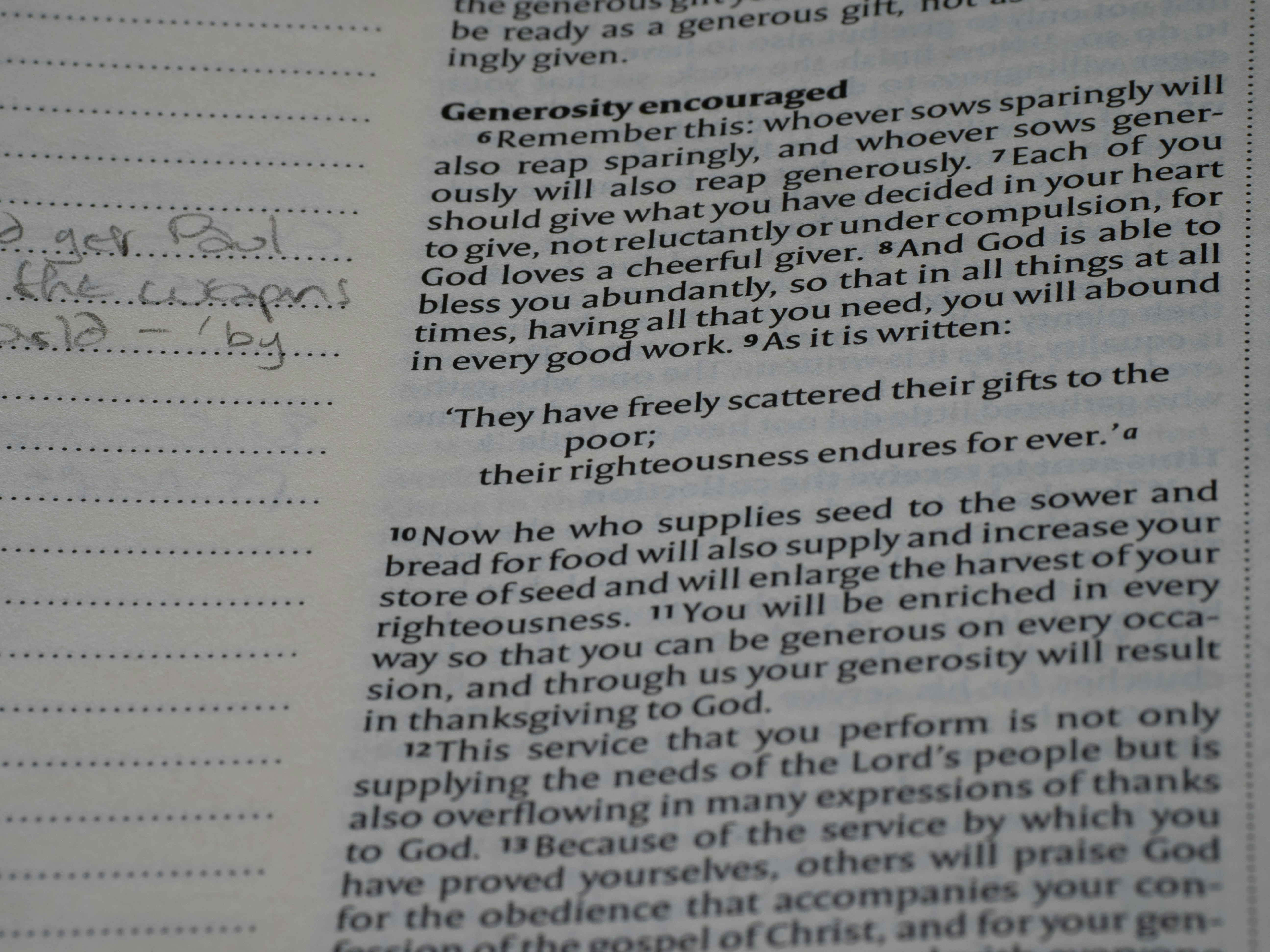
2 Corinthians 9:6-8 promises that cheerful, faith-driven generosity produces abundance—not always financial, but always spiritual. Acts 20:35 echoes Christ's words: "It is more blessed to give than to receive."
Studies of charitable behavior have generally found that consistent givers report higher levels of life satisfaction and greater financial discipline (National Bureau of Economic Research working paper on giving and well-being, 2024). Generosity isn't opposed to financial success—it's the fruit of it.
The hope we carry isn't in portfolio returns. It's in standing before Christ and hearing: "Well done, good and faithful servant" (Matthew 25:21).
Pray over your investments this week. Take one concrete step of obedience—whether reviewing your holdings, increasing your giving, or eliminating one debt. The song's not over yet.
Appendix: Key Bible Verses for Christian Investors
This appendix serves as a mini concordance—a quick reference for study, journaling, or small-group discussion.
Stewardship & Work:
- Matthew 25:14-30 — Multiply what's entrusted through wise investment decisions
- Proverbs 21:5 — Diligent planning leads to abundance; haste leads to poverty
Contentment & Avoiding Greed:
- Hebrews 13:5 — Be content; God will never leave you
- 1 Timothy 6:10 — Love of money is the root of all kinds of evil
- Luke 12:15 — Guard against covetousness; life isn't about abundance of possessions
Planning & Wisdom:
- Proverbs 21:20 — The wise store up treasure; the foolish consume everything
- Proverbs 22:7 — The borrower is slave to the lender
- Ecclesiastes 11:1-2 — Diversify investments across multiple ventures
Generosity & Justice:
- 1 Timothy 6:17-19 — Command the rich to be generous and ready to share
- 2 Corinthians 9:6-8 — Sow bountifully, reap bountifully; God loves a cheerful giver
- Proverbs 28:8 — Interest gathered unjustly will go to the generous
Eternal Perspective:
- Matthew 6:19-21 — Store treasure in heaven where your heart follows
- Luke 12:33-34 — Sell possessions, give to needy, gain unfailing treasure
Frequently Asked Questions for Christian Investors
Is it sinful to invest in the stock market? No. Proverbs 31:16-18 describes the noble woman who "considers a field and buys it" and sees that her profit is good. Investing in legitimate business ownership through stocks isn't sinful—what matters is your motive and method.
How much is "enough" for retirement? A common guideline is 25 times your annual expenses (the 4% withdrawal rule, originally derived from Bengen, 1994 and the Trinity Study, 1998). But Luke 12:21 challenges us to be "rich toward God," not just financially secure. Prayerfully consider what "enough" means for generous living.
What if my employer's 401(k) doesn't offer BRI funds? Many plans now offer self-directed brokerage windows or expanded fund menus (Plan Sponsor Council of America Annual Survey, 2024). Alternatively, contribute enough to get your employer match, then roll funds to an IRA with broader BRI options when eligible.
Is it okay to earn interest on bonds? Yes. Matthew 25:27 shows the master expected his servants to earn interest on entrusted money. Biblical prohibitions target exploitative usury (charging excessive interest to the poor), not legitimate fixed-income investing.
What's the difference between ESG and BRI? ESG (Environmental, Social, Governance) uses secular criteria—often climate-focused. BRI starts with biblical screens: avoiding abortion, pornography, and human trafficking first.
What about cryptocurrency? Approach with caution. Speculative assets driven by fear and greed run counter to Proverbs 13:11's warning about wealth made hastily. If you choose to allocate, many advisers suggest keeping exposure modest as a percentage of total portfolio.
Where can I find wise counsel? Proverbs 15:22 says plans succeed with many advisers. Seek NAPFA-registered Christian advisors or networks like Kingdom Advisors who are committed to fiduciary ethics and biblical finance principles, or explore firms like Openhanded Wealth for biblical financial planning.
If this was helpful, this one goes a level deeper: Christian Financial Planner: How to Find Faithful, Fiduciary Advice.
This content is provided for informational and educational purposes only and should not be construed as personalized investment, tax, or legal advice. Nothing contained herein constitutes a recommendation to buy or sell any security or to adopt any specific investment strategy. Strategies discussed may not be appropriate for all individuals and depend on each person’s unique financial circumstances. Investment advisory services are offered only pursuant to a written advisory agreement.
My goal is to use whatever gifts I have received to serve others, as a faithful steward of God’s grace in its various forms. (1 Peter 4:10)
Better is a handful, with quietness, than two handfuls with labor and striving after wind. -Ecclesiastes 4:6
Take the next step towards openhandedness and financial peace by booking a meeting with a Christian Financial Planner.