
Steward of Money Bible Verse: What Scripture Really Teaches About Managing God's Money

Most of us carry a mental picture of what it means to “manage money well.” Track expenses, avoid debt, save for retirement. But Scripture paints a different picture—one where we’re not really managing our money at all.
In the Bible, a steward of money is someone entrusted with resources that belong to another. In the 1st-century church, this wasn’t abstract theology. The early believers in Acts pooled possessions and distributed according to need, treating everything as a shared trust from God. That same framework runs from Genesis through Paul’s letters: God owns it all, and we’re the caretakers.
This article will give you the key bible verses on money stewardship quickly, then unpack what faithful stewardship looks like in your actual budget, your giving, and your long-term plans. With approximately 2,350 verses on money and possessions woven throughout Scripture, it’s clear that God desires His people to think carefully about how they handle financial resources. The principles Jesus taught in dusty Galilean villages still speak to believers navigating 2026’s financial complexity.
Key “Steward of Money” Bible Verses (Quick Answer)
If you came looking for specific steward of money bible verse references, here they are—each one a foundation for understanding how God’s word addresses our relationship with material wealth.
Psalm 24:1 establishes the theological starting point: “The earth is the Lord’s, and everything in it, the world, and all who live in it.” This includes your checking account, your retirement fund, and the cash in your wallet. God owns a thousand hills and the cattle on them—and everything else besides.
Deuteronomy 8:18 reminds Israel (around 1400 BC) that the ability to produce wealth comes from God: “Remember the Lord your God, for it is he who gives you the ability to produce wealth.” This isn’t passive—it connects stewardship to vocation and the work of your hands.
Matthew 6:19–21 comes from Jesus’ Sermon on the Mount (c. AD 28–30): “Do not store up for yourselves treasures on earth, where moth destroys and thieves break in and steal. But store up for yourselves treasures in heaven… For where your treasure is, there your heart will be also.” Financial decisions have eternal implications.
Matthew 6:24 presents the binary: “No one can serve two masters… You cannot serve both God and money.” Money is a tool, not a master. The moment it becomes the latter, we’ve stopped serving God.
Luke 12:15 carries Jesus’ direct warning: “Watch out! Be on your guard against all kinds of greed; life does not consist in an abundance of possessions.” This is a safeguard against the cultural tide that measures well being by accumulation.
Luke 16:10–13 teaches the principle of faithfulness in small matters: “Whoever can be trusted with very little can also be trusted with much… If you have not been trustworthy in handling worldly wealth, who will trust you with true riches?” Small financial decisions are training grounds.
Matthew 25:14–30 (the Parable of the Talents) shows accountability in action. A master entrusts servants with different amounts “according to his ability,” then returns to settle accounts. The faithful servant who invested well hears, “Well done, good and faithful servant!” We will give an account.
1 Timothy 6:17–19 contains Paul’s instruction to wealthy believers (c. AD 63–65): “Command those who are rich in this present world not to be arrogant nor to put their hope in wealth, which is so uncertain, but to put their hope in God… Be generous and willing to share. In this way they will lay up treasure for themselves as a good foundation for the coming age.”
What Is Biblical Stewardship of Money?
Biblical stewardship of money means managing God’s resources according to God’s priorities—not treating wealth as something we own outright, but as something entrusted to our care. The bible teaches that we are caretakers, not proprietors.
Think of it like managing a company’s budget or serving as trustee for an estate. You have real authority and responsibility, but you’re accountable to someone else for how you use the resources. The same way applies to every dollar that passes through your hands.
Four core components shape this understanding:
Ownership belongs to God. As Psalm 24:1 and 1 Chronicles 29:11–12 make clear, everything in heaven and earth belongs to the Lord Almighty. Our financial statements simply reflect temporary custody.
Responsibility flows from entrustment. From Genesis 2:15’s call to “tend and keep” creation to the Parable of the Talents, Scripture shows that God assigns resources according to ability and expects wise management.
Accountability is inevitable. Romans 14:12 states that “each of us will give an account of ourselves to God.” Luke 16:2 pictures a master demanding, “Give an account of your management.” This isn’t punitive—it’s relational. We’re answerable to the One who entrusted us.
Reward follows faithfulness. Matthew 25:21 records the master’s response: “Well done, good and faithful servant! You have been faithful with a few things; I will put you in charge of many things.” Faithful stewardship opens doors to greater responsibility—both now and in the present age to come.
Why Stewardship of Money Matters for Every Christian
How you handle money reveals whom you trust and what you value. It’s not a peripheral topic for Sunday school—it’s central to discipleship.
Consider that Jesus spoke about money more than almost any other subject. Roughly 15% of His recorded teachings address wealth and possessions, and 16 of His 38 parables touch financial themes (Howard Dayton, Compass—Finances God’s Way). This wasn’t accidental. The Lord Jesus understood that our relationship with money exposes the true state of our hearts.
Here’s why money stewardship matters for every believer:
It reveals heart orientation. Matthew 6:21 says, “Where your treasure is, there your heart will be also.” Your bank statement is a kind of spiritual diagnostic. Where the dollars go, affection follows.
It impacts families and generations. Proverbs 13:22 speaks of the righteous leaving an inheritance, while the sinner’s wealth is “laid up for the righteous.” Proverbs 21:5 connects diligent planning to abundance and haste to poverty. Your stewardship decisions ripple forward.
It fuels gospel ministry. Acts 2:44–45 describes early Christians sharing possessions so “there were no needy persons among them.” Financial decisions aren’t separate from mission—they enable it.
It protects against spiritual dangers. Greed and anxiety are both addressed through faithful stewardship. Luke 12:15 warns against covetousness. Matthew 6:25–34 addresses worry about provision. Hebrews 13:5 teaches contentment.
In 2026, with investment apps and credit offers at our fingertips, these principles aren’t less relevant—they’re more necessary.
Generosity: The Heart of a Godly Money Steward
The most visible mark of a steward of money in the Bible isn’t accumulation—it’s generosity. If stewardship is managing God’s resources God’s way, then generosity is the natural outflow.
Proverbs 11:24–25 presents the paradox: “One person gives freely, yet gains even more; another withholds unduly, but comes to poverty. A generous person will prosper.” These proverbs describe general spiritual principles, not guaranteed financial outcomes.
Malachi 3:8–10 calls Israel to “bring the whole tithe into the storehouse.” This Old Testament covenant promise illustrates God’s heart toward generosity, though it should not be read as a guarantee of specific financial returns.
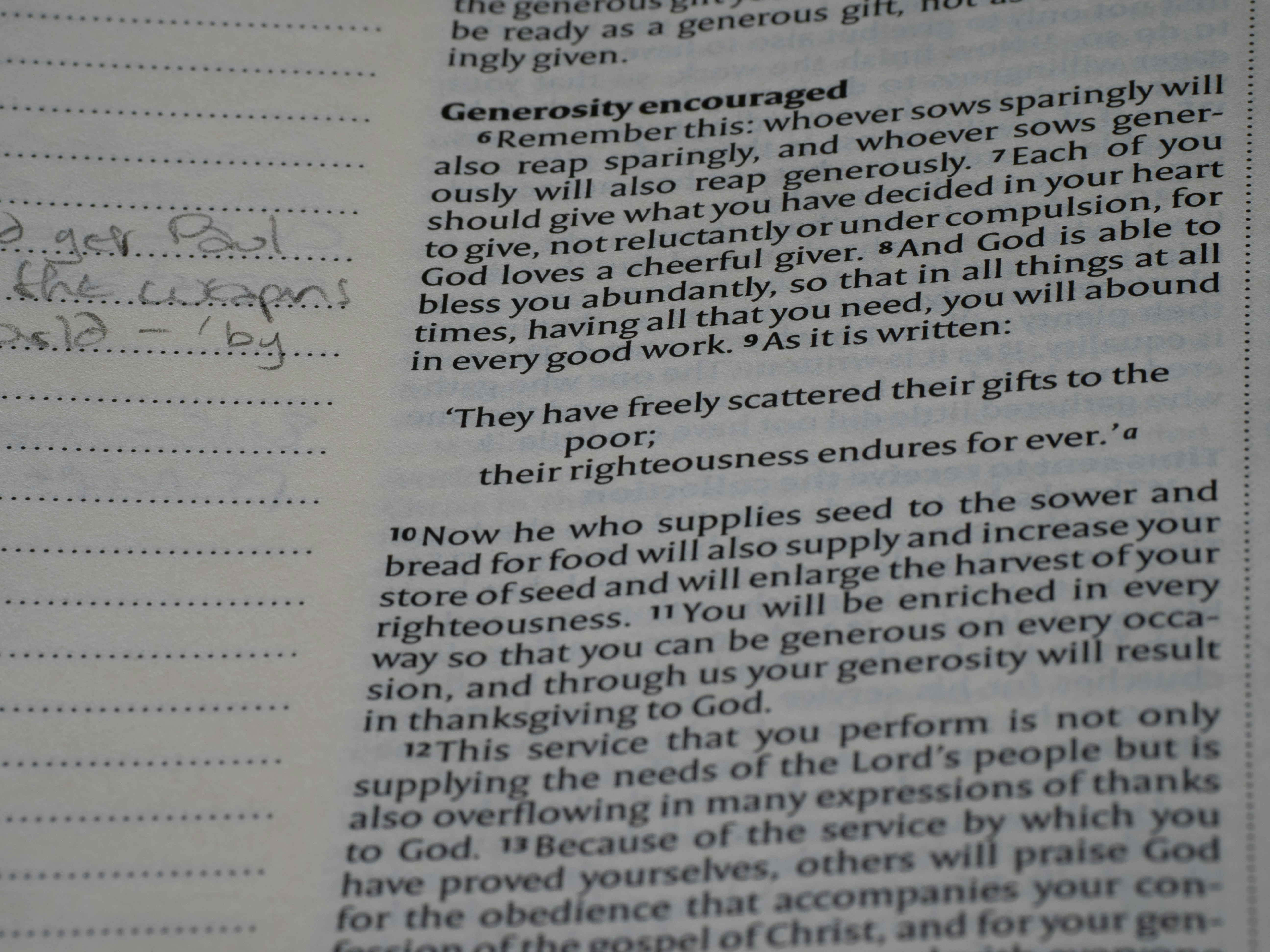
2 Corinthians 9:6–8 ties attitude to action: “Whoever sows sparingly will also reap sparingly, and whoever sows generously will also reap generously… for God loves a cheerful giver.”
Practical Ways to Live as a Steward of Money Today
Here’s how to translate steward of money bible verse teaching into everyday steps:
- Create a written budget that reflects biblical priorities: giving first, saving second, needs third, wants last.
- Start with consistent percentage giving. Tithing at 10% is a historic baseline (Leviticus 27:30, Genesis 14:20).
- Build an emergency fund gradually. Proverbs 21:20 pictures the wise storing up resources.
- Reduce consumer debt. Proverbs 22:7 warns that “the borrower is slave to the lender.”
- Practice contentment daily. Philippians 4:11–13 shows Paul learning contentment through Christ’s strength.
- Include accountability. Many find it helpful to work with a Christian financial planner like Nick Garofalo at Openhanded Wealth.
Conclusion
The pattern is consistent throughout Scripture: God owns everything. We are stewards. The Bible gives clear principles for wise management. And every believer is called to handle money in ways that reflect God’s glory.
The key steward of money bible verse passages—Matthew 6:24’s call to serve God rather than money, Luke 16:10’s emphasis on faithfulness in small things, 1 Timothy 6:17–19’s instruction to be generous—point toward the same destination: trusting God with our resources and holding them with open hands.
If this was helpful, this one goes a level deeper: Biblical Financial Advice: A Stewardship Roadmap for Real Life.
This content is provided for informational and educational purposes only and should not be construed as personalized investment, tax, or legal advice. Nothing contained herein constitutes a recommendation to buy or sell any security or to adopt any specific investment strategy. Strategies discussed may not be appropriate for all individuals and depend on each person’s unique financial circumstances. Investment advisory services are offered only pursuant to a written advisory agreement.
My goal is to use whatever gifts I have received to serve others, as a faithful steward of God’s grace in its various forms. (1 Peter 4:10)
Better is a handful, with quietness, than two handfuls with labor and striving after wind. -Ecclesiastes 4:6
Take the next step towards openhandedness and financial peace by booking a meeting with a Christian Financial Planner.