
Biblical Wealth Principles: How Scripture Shapes Wise Stewardship Today

Consider a hypothetical couple in 2026—call them James and Sarah—sitting at their kitchen table after the kids are in bed. They’re staring at $15,000 in credit card debt, a savings account that wouldn’t cover two months of rent, and a growing anxiety that something needs to change. They’ve worked hard. They tithe when they can. But the numbers don’t seem to add up, and neither does the stress.
So they do something that feels almost countercultural: they open god’s word together and start reading Proverbs 3:9-10. “Honor the Lord with your wealth… then your barns will be filled to overflowing.”
They’re not looking for a magic formula. They’re looking for a firm foundation.
That’s what biblical wealth principles offer—not a prosperity scheme, but a framework for how god’s people should view, earn, manage, give, and enjoy money. The bible teaches that wealth itself isn’t the problem. Abraham was “very rich in livestock, in silver, and in gold” (Genesis 13:2). King Solomon’s riches surpassed all the kings of the earth. The issue is never the money—it’s what the money does to our hearts.
Throughout the bible, we find consistent patterns:
- God owns everything; we’re stewards, not owners
- Diligent work is the ordinary means of provision
- Debt carries real spiritual and practical risk
- Contentment guards against the love of money
- Generous giving reflects God’s own character
- Wise planning honors both present needs and future uncertainty
Let’s unpack each of these biblical financial principles and see how they speak into life today.

God Owns It All: The Foundation of Biblical Wealth
Here’s the first principle that reframes everything: god owns it all.
Psalm 24:1 puts it plainly: “The earth is the Lord’s, and everything in it.” Haggai 2:8 echoes this: “The silver is mine and the gold is mine, declares the Lord Almighty.” If we miss this, we’ll misunderstand everything else about biblical money management.
This isn’t just theology—it’s deeply practical. If god has given us resources to manage on his behalf, then every financial decision becomes an act of stewardship, not just personal preference. We’re accountable. That changes things.
Consider a few examples from Scripture:
- Abraham’s vast flocks in Genesis 13 were entrusted to him under God’s covenant promise—he didn’t self-manufacture his wealth
- David, with all his royal treasury, publicly acknowledged in 1 Chronicles 29: “Everything comes from you, and we have given you only what comes from your hand”
- The Parable of the Talents (Matthew 25:14-30) judges servants not on how much they received, but on their faithfulness with what was entrusted
Here’s how this plays out in practical suggestions for your own financial stewardship:
- Pray before major purchases—not as superstition, but as acknowledgment of whose money it really is
- Track your spending as an act of keeping records for the Owner, not just for your own budget
- Conduct an annual “stewardship review”—look at income, expenses, and giving to see if your money management reflects your stated values
- Ask regularly: “Am I using this resource in a way that honors the One who entrusted it to me?”
When we forget that god owns everything, anxiety, greed, and fear take root. But when we embrace biblical stewardship, something shifts. Peace replaces panic. Clarity replaces confusion. Our financial situation stops feeling like a burden we carry alone.
Wealth, Temptation, and the Call to Contentment
Scripture doesn’t just encourage wise money management—the bible warns us directly about wealth’s spiritual dangers.
1 Timothy 6:9-10 doesn’t mince words: those who desire to be rich “fall into temptation, a trap, into many foolish and harmful desires that plunge people into ruin.” The love of money, Paul writes, is “a root of all kinds of evil.” Jesus told his disciples to “watch out and be on guard against all kinds of greed” (Luke 12:15). The rich young ruler in Mark 10 kept all the commandments but couldn’t part with his material possessions—and walked away from the lord jesus christ grieving.
The problem isn’t having enough money. The problem is when money has us.
In 2026 terms, this shows up as:
- Careerism that devours family time and spiritual health
- Lifestyle inflation where every raise leads to a bigger house, nicer car, and more stress
- Status purchases driven by social comparison rather than actual need
- The quiet belief that more material wealth will finally bring security
The antidote is contentment—and it’s learned, not automatic. Paul wrote in Philippians 4:11-13 that he had “learned the secret of being content in any and every situation,” whether well-fed or hungry, and that this came through christ jesus who gave him strength. Hebrews 13:5 commands: “Keep your lives free from the love of money and be content with what you have.”
Here are a few concrete ways to cultivate contentment in a culture that constantly whispers “more”:
- Start a daily gratitude practice—research suggests gratitude is associated with reduced materialism and greater well-being
- When income grows, cap your lifestyle at a set percentage rather than letting spending rise with every raise
- Choose the modest car when you could afford luxury—not out of guilt, but out of freedom
- Spend time regularly in quiet time reflecting on what “enough” actually means for your family
Contentment isn’t settling. It’s trusting god that what you have is sufficient for today.
Diligent Work: How God Normally Provides
If contentment guards the heart, diligent work is how provision usually arrives. Scripture is remarkably consistent on this: the diligent makes rich, while lazy hands lead to poverty (Proverbs 10:4).
Proverbs 12:11 says, “Those who work their land will have abundant food, but those who chase fantasies have no sense.” Proverbs 22:29 promises that skilled workers “will serve before kings.” And 2 Thessalonians 3:10 makes it blunt: “If anyone is not willing to work, let him not eat.”
This isn’t a prosperity gospel—it’s just how God normally provides.
Consider a few examples from Scripture:
- Joseph rose from prison to become Egypt’s vizier through administrative excellence (Genesis 41), stewarding resources that would save nations from famine
- Lydia was a “dealer in purple cloth” (Acts 16:14)—a successful businesswoman whose work ethic opened doors for the gospel
- Paul made tents (Acts 18:3) to fund his ministry, modeling self-reliance and integrity
For those of us in 2026—whether working a 9-5, freelancing in the gig economy, or running a small business—the application is straightforward:
- View your work as service to God, not just a paycheck (Colossians 3:23)
- Pursue excellence and skill development as an act of worship
- Maintain integrity in all financial dealings—refuse dishonest gain, even when it’s profitable
- Recognize that “get rich quick” schemes almost always violate scriptural wisdom (Proverbs 13:11)
The bible teaches that prosperity without effort is suspect. The wise store up through steady, faithful work—not through shortcuts or schemes.
Debt, Savings, and Wise Planning
Proverbs 22:7 offers one of Scripture’s most sobering financial principles: “The rich rules over the poor, and the borrower is slave to the lender.”
That word “slave” should give us pause. Biblical financial principles don’t absolutely forbid all borrowing—but they treat debt as bondage, something to enter rarely and exit quickly. Romans 13:8 reinforces this: “Let no debt remain outstanding, except the continuing debt to love one another.”
At the same time, Scripture commends saving and planning. Proverbs 6:6-8 points to the ant who “stores up provisions in summer.” Proverbs 21:20 notes that “the wise store up choice food and oil, but fools gulp theirs down.” The foolish man consumes everything now; the wise person prepares for what’s coming.
Here’s what this looks like in practical terms:
- Build a 3-6 month emergency fund—this isn’t hoarding; it’s prudent preparation for life’s inevitable surprises
- Prioritize paying off high-interest credit card debt before investing aggressively
- Avoid consumer loans for depreciating items like vacations or luxury goods
- Use tools like zero-based budgeting where every dollar has a purpose before the month begins
- Consider sinking funds for predictable large expenses (car repairs, medical costs, home maintenance)
- Carry basic insurance—it’s a form of the foresight Proverbs 22:3 commends
The goal isn’t to become wealthy through clever financial engineering. It’s to practice the kind of biblical perspective that honors God with wise planning while trusting him for what we can’t control.

Generosity: Giving as an Act of Worship
If there’s one theme that runs throughout Scripture’s teaching on money, it’s this: god loves a cheerful giver.
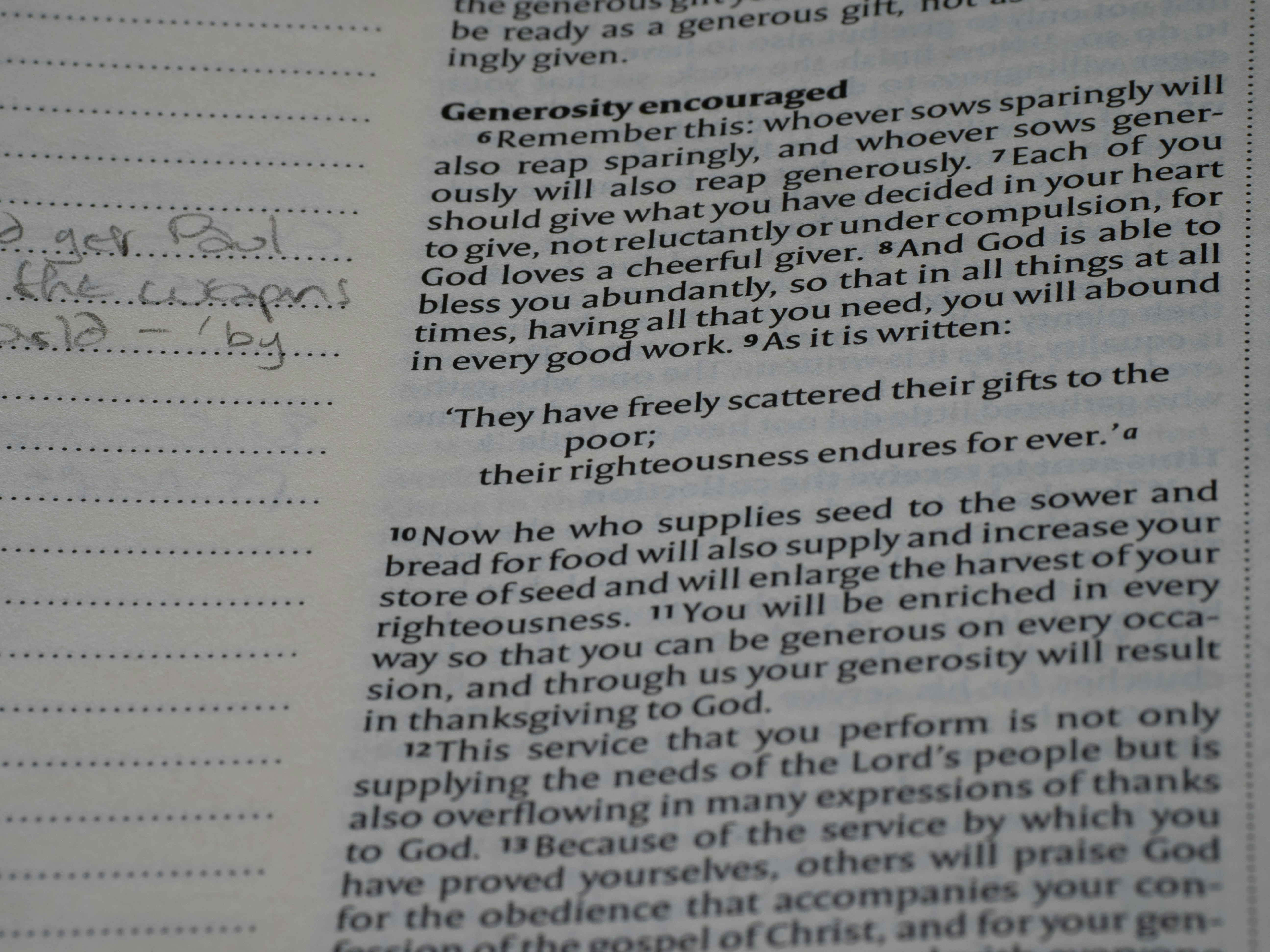
2 Corinthians 9:6-7 captures it perfectly: “Whoever sows sparingly will also reap sparingly, and whoever sows generously will also reap generously… God loves a cheerful giver.” Proverbs 11:24-25 adds a paradox: “One person gives freely, yet gains even more; another withholds unduly, but comes to poverty.” Acts 20:35 records Jesus’ own words: “It is more blessed to give than to receive.”
A generous person doesn’t give reluctantly or under compulsion—they give joyfully, recognizing that generosity is worship.
Historically, tithing appears before the Law (Abraham gave Melchizedek a tenth in Genesis 14) and was formalized in Malachi 3:10. But New Testament giving emphasizes the heart: sacrificial, proportional, and cheerful. The measure pressed down shaken together and running over that jesus taught about in Luke 6:38 isn’t about prosperity—it’s about the kind of life that flows from open-handed generosity.
Here’s how this plays out practically:
- Support your local church regularly—this is the primary context for New Testament giving
- Give to local poverty relief (food banks, shelters, neighbors in need)
- Support global missions and organizations extending God’s kingdom
- Practice spontaneous generosity when you encounter need—covering a bill, buying groceries, meeting a specific request
- Involve your family in giving decisions so children learn that money is a tool for blessing others
The ultimate pattern is Christ himself. 2 Corinthians 8:9 reminds us: “Though he was rich, yet for your sake he became poor, so that you through his poverty might become rich.” The very thing we’re called to do—give generously—is what God himself has done for us.
Building a Biblical Financial Framework for Your Family
Knowing biblical principles is one thing. Building them into your family’s actual life is another.
This is where the holy spirit’s work meets practical planning. Rather than copying someone else’s budget, the goal is to translate biblical wealth principles into your own family’s written values and guidelines.
Here’s a process that works, especially when paired with a broader study of bible verses about finances and stewardship:
- Pray together as a couple or family—invite God into your financial affairs explicitly
- Study key passages together: Matthew 6:19-34, 1 Timothy 6:6-19, Proverbs 3:9-10
- Create a one-page “family financial statement of faith”—a simple document that captures your commitments
Your family’s commitments might include things like:
- Capping housing costs at 25-30% of income
- Giving a set percentage (10% or more) consistently
- Avoiding consumer debt entirely
- Reviewing financial goals together every January
- Seeking godly counsel before major financial decisions, which may include working with a Christian financial planner committed to biblical stewardship
For families with children, this is also an opportunity for good stewardship training:
- Assign chores with small allowances to teach work-money connection
- Help kids create simple budgets with give/save/spend categories
- Involve them in family giving decisions—let them see generosity in action
- Discuss financial decisions openly so they learn the “why” behind your choices
The goal isn’t rigid rules but a living framework that shapes your family’s relationship with money for generations.
Applying Biblical Wealth Principles in a Modern Economy
Ancient Israel didn’t have index funds, gig work, or elevated housing costs. So how do financial principles found in Scripture translate to life in the present world?
The principles don’t change—but their application requires wisdom.
In 2026, we face realities like digital payments, online investing, student loan burdens, and economic volatility. Here’s how to evaluate modern tools through a biblical perspective:
- Mortgages: Generally acceptable if they’re prudent (under 25-30% of income) and you’re not over-leveraging for status
- Index funds: A reasonable way to practice diversification (Ecclesiastes 11:2 says “invest in seven ventures, yes, in eight”)
- Student loans: Enter cautiously with a clear repayment plan—the borrower is still slave to the lender
- Side hustles: Can reflect diligent work, but watch for burnout and family neglect
- Digital budgeting tools: Helpful for keeping records and practicing stewardship accountability
Proverbs 15:22 reminds us that “plans fail for lack of counsel, but with many advisers they succeed.” Seek counsel from wise believers and qualified advisors who share biblical ethics, including faith-based financial planners who integrate biblical stewardship into planning and investing. Openhanded Wealth LLC, which authored this article, is one example of a fee-only, faith-based RIA — but we encourage you to seek multiple advisors and compare before deciding. Don’t navigate complex financial decisions alone.
Consider these illustrative scenarios:
- Job offer decision: A 20% raise sounds great, but if it costs your family time and spiritual health, is it worth it? (1 Timothy 5:8 calls us to provide for family—not just financially)
- House purchase: Choose based on actual need and contentment, not neighborhood prestige or fear of missing out
- Variable income season: Give proportionally (1 Corinthians 16:2)—when income is high, give more; when it’s lean, give faithfully from what you have
Biblical money management doesn’t mean avoiding the modern economy. It means engaging it with discernment, generosity, and trust in God rather than trust in the whole world’s systems.

Conclusion: True Wealth in God’s Kingdom
Biblical wealth principles aren’t primarily about financial success as the world measures it. They’re about becoming faithful stewards who hold material possessions loosely, trusting god for provision, and using resources for his glory and others’ good.
The major themes we’ve covered—God’s ownership, diligent work, wise planning, caution with debt, deep contentment, and joyful generosity—all point toward the same reality: our financial affairs reveal our hearts.
Jesus taught that where our treasure is, our hearts will be also (Matthew 6:21). He warned that we cannot serve both God and money. And he promised that those who seek first his kingdom will find that everything else falls into place.
The great gain Scripture speaks of isn’t a bigger portfolio—it’s godliness with contentment (1 Timothy 6:6). It’s the kind of godly character that values eternal life over temporary accumulation. It’s good deeds that outlast any bank account.
So here’s a simple next step: choose one principle from this article and act on it this week. Maybe it’s starting a budget. Maybe it’s having that giving conversation with your spouse. Maybe it’s paying down a specific debt or building an emergency fund.
The song isn’t over yet. Your next financial decision is an opportunity to trust God more deeply—and to discover that true wealth was never about the numbers in the first place.
If this was helpful, this one goes a level deeper: Christian Financial Planner: How to Find Faithful, Fiduciary Advice.
This content is provided for informational and educational purposes only and should not be construed as personalized investment, tax, or legal advice. Nothing contained herein constitutes a recommendation to buy or sell any security or to adopt any specific investment strategy. Strategies discussed may not be appropriate for all individuals and depend on each person’s unique financial circumstances. Investment advisory services are offered only pursuant to a written advisory agreement.
My goal is to use whatever gifts I have received to serve others, as a faithful steward of God’s grace in its various forms. (1 Peter 4:10)
Better is a handful, with quietness, than two handfuls with labor and striving after wind. -Ecclesiastes 4:6
Take the next step towards openhandedness and financial peace by booking a meeting with a Christian Financial Planner.