

An email landed in my inbox this week from Cody Hobelmann, cofounder of the Finish Line Pledge and cohost of the Finish Line Podcast. It made a case about biblical generosity that most financial plans argue against, including some I have helped build.
Cody opened with a confession. When he started out, he wanted to be rich. Not for the boat. He wanted to be rich so he could give more away. He had heard the stories about people handing over millions, giving away ownership in a business, and he wanted in. So he made a plan: build, invest, compound, and then somewhere near the end of the run, write the big checks.
Then he wrote this line: "But as usual, God had other plans."
The deferral instinct is the most respectable bad habit in finance
Cody's original plan was the responsible version. Nobody would call it greedy. It is what a good advisor draws on the whiteboard. Maximize the asset, minimize the tax drag, deploy at the end when the number is biggest.
The math behind it is not stupid either. If you are a business owner sitting on a concentrated position in your own company, there are real reasons a gift five years from now could be larger and more tax-efficient than a gift today. Appreciated stock, a liquidity event, a donor-advised fund funded at the right moment. Those tools exist and in many situations they work well. I use them with clients.
But somewhere in there, "later" stopped being a strategy and became a personality. I have sat across the table from enough people to notice the pattern: the people who plan to become generous later usually stay exactly as generous as they are right now, just with bigger balance sheets.
Cody's argument, drawn from years of conversations with unusually thoughtful and generous people, is that in most cases it is better to give now than later. He gave ten reasons. All ten earn their keep, and they cluster into four ideas.
Idea one: biblical generosity is a skill, and skills require reps
1. Giving is a muscle. Generosity gets easier when it is practiced often over a long time. The first gift is the hardest one you will ever make. Every time you stretch, a whole new tier of giving becomes reachable. Nobody deadlifts 400 pounds on day one. Nobody writes a seven-figure check on day one either, and if they do, it costs them something that ten years of practice would have already made cheap.
2. Effectiveness comes with practice. A dollar given after ten years of consistent generosity tends to land better than a dollar given for the first time, because by then you know where to send it. Giving well is a competency. You learn which organizations execute and which ones have good branding. You learn what happens after the check clears. Wisdom in giving comes from giving, watching the results, and adjusting. You cannot download it at retirement.
3. It takes time to hear the Spirit. A pattern of generosity increases your sensitivity to the opportunities in front of you. If you are not in the habit of giving, you tend not to notice the moments when you are supposed to. Learning to follow the Spirit's lead here works the way it works everywhere else, through repetition until you recognize the nudge when it comes.
All three are arguments about you rather than about the money. The deferral plan assumes you will be the same person in 2045 that you are today, only richer and more generous. That is not how people work. We become what we repeatedly do, and a plan to be generous later is a plan to spend thirty years practicing accumulation and then expecting to be good at something you have never done.
Idea two: impact ripples outward through people
4. Impact is not measured on the same scale as interest. Cody's claim is that a life changed today, working forward over twenty years, does more than the same dollar left to accumulate. That is not a comparison anyone can run in a spreadsheet, and I am not going to pretend otherwise. Treat it as a statement about what you value rather than a projection of results. What I will say is that a dollar's financial return is bounded by the market, and what a gift does in someone's life is not measured on that scale at all.
5. Generosity inspires generosity. Giving across the course of your life creates hundreds of moments where somebody watches you do it. Your kids see it, your employees see it, and so does the guy in your small group who has been sitting on the fence for two years. Inspired generosity can reach places your own giving never would. A single gift at the end, however large, reaches far fewer people. Most of them read about it in a will.
6. Giving builds relationships. Whether you are giving to a person or an organization, generosity creates a relationship with the recipient. Give now and you get to enjoy the fruit of those relationships for years. Give at the end and you are handing money to strangers you never met, hoping the org chart has not changed.
This is the strongest practical argument in the stack, and it contradicts the accumulate-then-deploy model most directly. That model treats a gift as a transfer of dollars. A gift moves dollars, and it also carries a relationship and an example. Those are often the parts that keep bearing fruit after you are gone.
Idea three: the pile you are protecting may not survive the wait
7. Moth and rust destroy. "Do not lay up for yourselves treasures on earth, where moth and rust destroy and where thieves break in and steal" (Matthew 6:19). Treasure given today is locked in for eternity. Treasure held so you can give it tomorrow may not be there when tomorrow shows up. Ask anyone who was two years from a planned liquidity event in 2008.
8. You don't know how much time is left. Ron Blue has spent a career repeating a line usually credited to Ann Landers: do your giving while you're living so you're knowing where it's going. Jesus put it more bluntly in Luke 12:16-21, where a man builds bigger barns to hold a bumper crop and does not make it to morning.
A giving plan that depends on you living to 85, your business selling at the multiple you have in your head, and the market cooperating for two more decades is a hope with a spreadsheet attached. Every one of those variables sits outside your control. The gift you make this month does not.
Idea four: the part that never shows up on the balance sheet
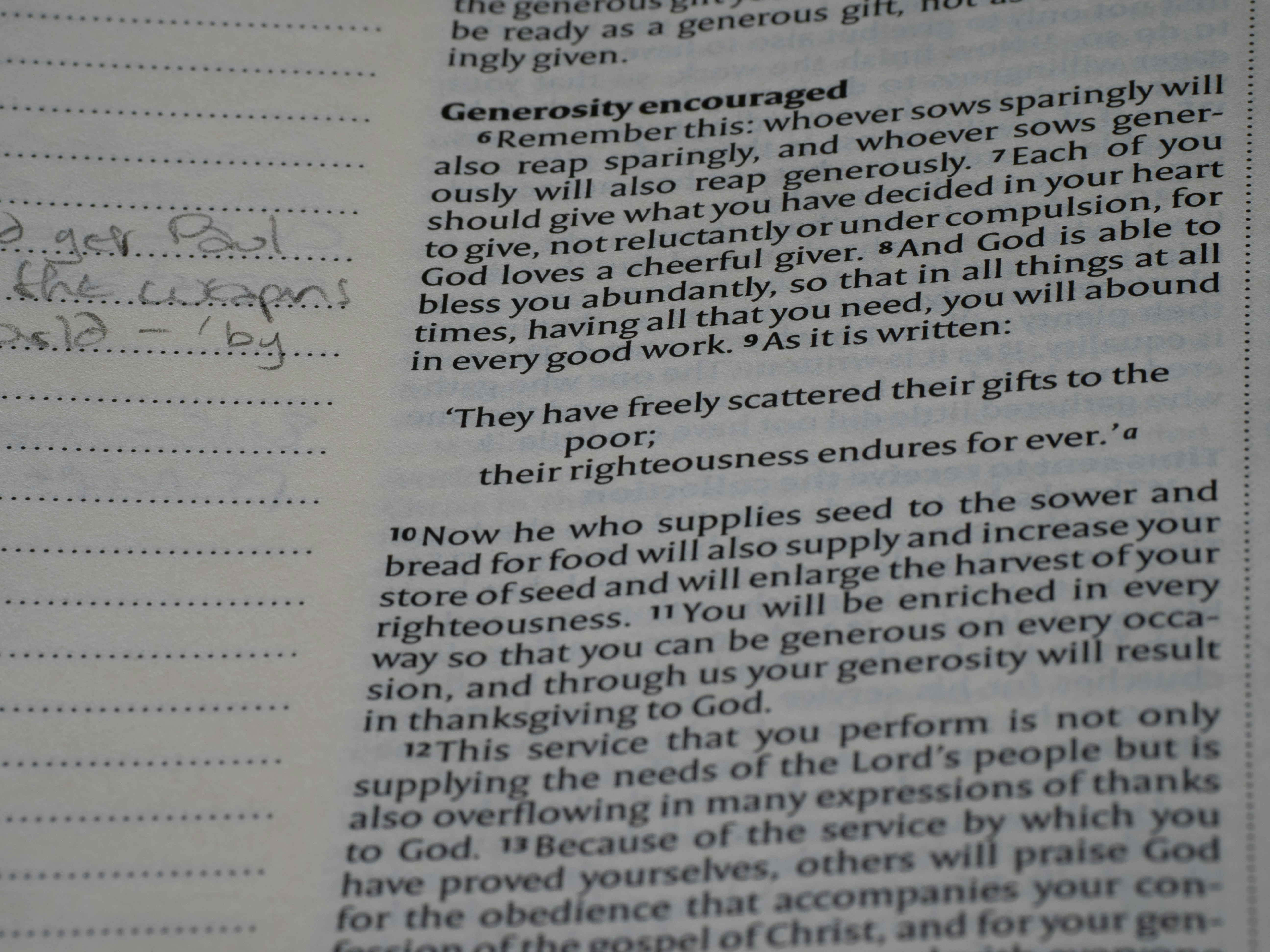
9. Giving is fun. There is no good reason to push off one of the most joy-filled things you get to do with money. "He who supplies seed to the sower and bread for food will supply and multiply your seed for sowing" (2 Corinthians 9:10). Paul's point is about who owns the supply. That is a statement of trust and not a forecast about your accounts. Deferring generosity to protect optionality trades something you would enjoy now for something you might enjoy later, which is a trade most people regret in every other area of life.
10. God cares more about your heart than your money. The other nine sit underneath this one. God does not need your money. He wants you. Jesus frames it as a diagnosis in Matthew 6:24, where no one can serve two masters. Generosity is one of the most powerful acts of faith available to us and one of the fastest ways to learn to trust God with the thing we are most tempted to trust instead of Him. Postponing that postpones the actual work, whatever tax reasoning is attached to it.
What this looks like on the first of the month
People hear an argument like Cody's, feel convicted, write one larger-than-normal check, and go right back to the old pattern. That is a mood. The change is a line item.
Give generosity a fixed, named place in your monthly cash flow, the same way your mortgage and your payroll and your retirement contribution have one. Not a percentage you calculate at year-end out of whatever is left. A number that comes off the top, on a schedule, before the rest of the plan gets to argue with it. If you are not sure where to set that number, I worked through how much you can give without being foolish about it in a separate post. Pick the amount, pick the date, and automate the transfer into a separate account or a donor-advised fund so the money is already designated before you have a chance to renegotiate with yourself. For business owners, that often means building it into the distribution schedule rather than treating it as a personal afterthought.
The first gift stops being agonizing once it stops being a decision and becomes a default. The stretch gifts get easier because you have built the muscle. And you start noticing opportunities you used to walk past, because the capital is already set aside and you no longer have to talk yourself into anything.
None of that requires abandoning good tax stewardship. Appreciated securities, donor-advised funds, qualified charitable distributions, and bunching (stacking two or three years of giving into a single tax year) are all still on the table, and depending on your situation they may make your giving go further. Those are conversations worth having with your CPA and your advisor, because the right answer depends on your income, your entity structure, and your holdings. Those are questions of how. The ten reasons above are questions of when. Do not let the how become an excuse to keep postponing the when.
Cody planned to give at the end, and God had other plans. The plan to become generous later has a way of never arriving. The line item arrives on the first of the month.
Want some help thinking this through? I did too. That's part of why I started Openhanded Wealth: to walk with folks like you through decisions that feel complicated, but don't have to stay that way. If you've got questions, reach out. I'm a real person. I'll help you think clearly, and I won't push you into decisions that don't fit. You can also learn more about how I work with clients. You don't have to navigate this alone. [Email Me], or [Schedule a Call]
The ten reasons in this post are drawn from a newsletter by Cody Hobelmann, cofounder of the Finish Line Pledge and cohost of the Finish Line Podcast, shared with appreciation.
This content is provided for informational and educational purposes only and should not be construed as personalized investment, tax, or legal advice. Nothing contained herein constitutes a recommendation to buy or sell any security or to adopt any specific investment strategy. Strategies discussed may not be appropriate for all individuals and depend on each person’s unique financial circumstances. Investment advisory services are offered only pursuant to a written advisory agreement.
My goal is to use whatever gifts I have received to serve others, as a faithful steward of God’s grace in its various forms. (1 Peter 4:10)
Better is a handful, with quietness, than two handfuls with labor and striving after wind. -Ecclesiastes 4:6
Take the next step towards openhandedness and financial peace by booking a meeting with a Christian Financial Planner.