

Can I Give More Without Being Foolish?
You check the accounts. The numbers are fine, maybe better than fine. And still, the thought of writing a bigger check to your church, or funding a scholarship, or helping your sister with her mortgage, triggers something close to panic. Not because you can't afford it on paper. Because you don't actually know if you can afford it, and "I don't know" feels a lot safer to sit with than "we can, and I said no anyway."
That's the tension underneath this question. Not "should I give?" You already know the answer to that one. The harder question sits underneath it: how much can I give without being reckless with my family's future?
Most people never get a straight answer, so they default to a feeling. Some feel guilty every time they give, like they're gambling with their kids' college fund. Others feel guilty every time they don't give, like generosity is a box they're supposed to check and haven't checked enough. Both are exhausting. Both are also solvable, and not with more willpower. With more clarity.
The two failure modes
I see two patterns show up over and over with households who are doing well financially.
The first is the white-knuckle giver. They give, but every gift costs them peace. They round down. They hesitate before increasing anything. Somewhere in the back of their mind is an unspoken number (the amount that would finally make them feel safe), and they've never written it down, so it keeps moving. It's always a little further away than where they currently are. This is fear wearing the costume of prudence. It looks responsible. It often isn't. It's just anxiety that's learned to dress for church.
The second is the guesser. They give generously, sometimes impressively, but without much of a framework behind it. It's less "here's what we can sustainably do" and more "this felt like the right amount in the moment." That's not always wrong, but it's fragile. It tends to break down exactly when it matters most: a slow year, a business downturn, a season of unusually high expenses. There was never a real ceiling or floor to work from. Just a feeling, and feelings move.
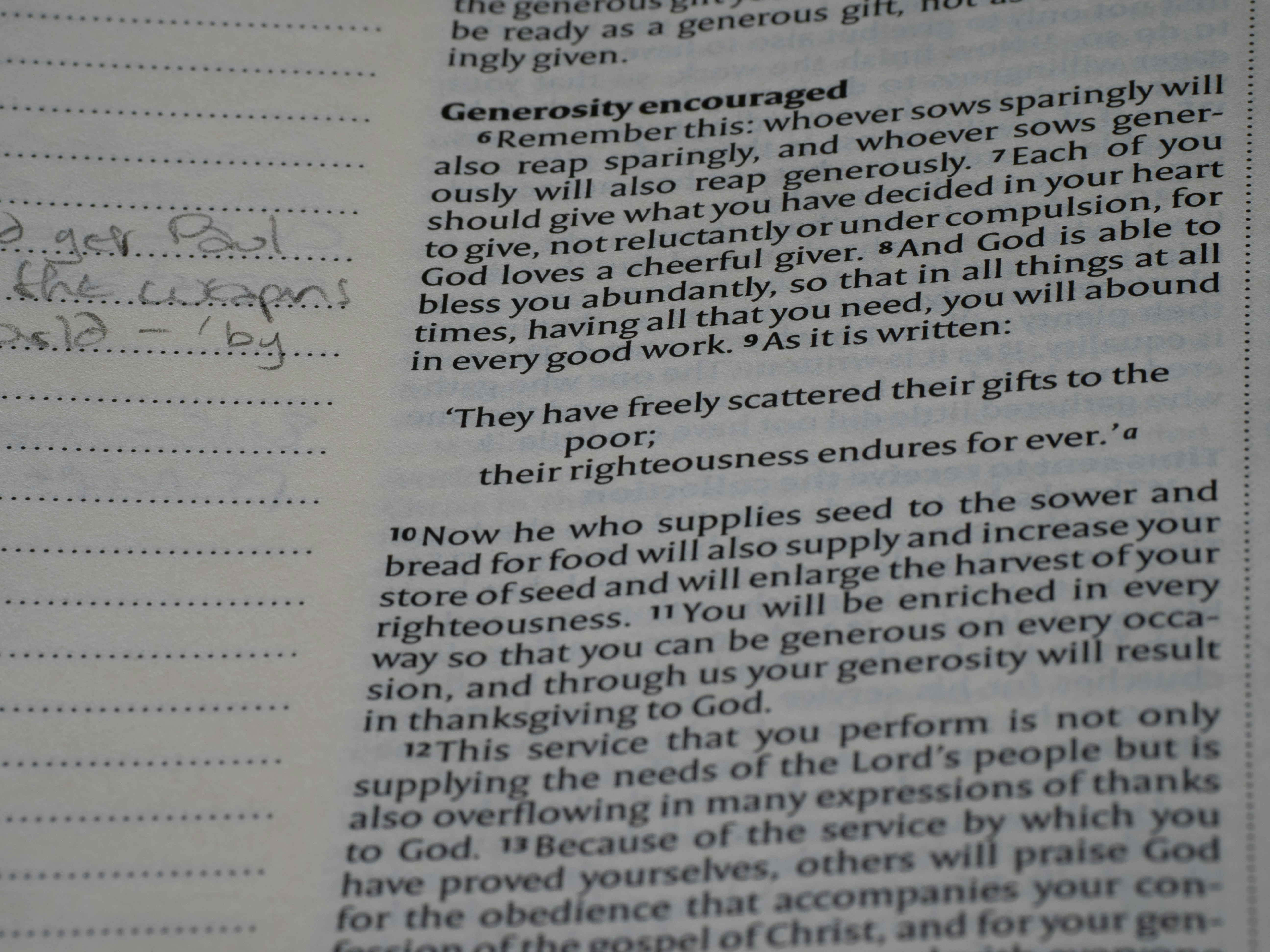
Neither pattern is really about the money. Both are about not having a clear line between "this is ours to steward carefully" and "this is free to give away." Without that line, every generosity decision gets re-litigated from scratch, every single time. That's a heavy way to live, and it's not how Scripture describes giving. Paul tells the Corinthians that each person should give "as he has decided in his heart, not reluctantly or under compulsion, for God loves a cheerful giver" (2 Corinthians 9:7). Reluctance and compulsion are both the absence of clarity. Cheerful giving requires you to actually know what you're looking at.
Provision is God's job. Stewardship is yours.
Here's where the two get confused. A lot of financially responsible Christians believe, without ever saying it out loud, that if they don't personally guard every dollar against every possible future, they're the ones holding the family's safety net together. It's an understandable belief. It's also not true, and it's not the posture Scripture asks of you.
You are not called to be your family's ultimate provider. You're called to be a faithful steward of what's currently in your hands. Those are different jobs. One is God's. One is yours. When you collapse the two, every dollar you give away starts to feel like you're personally weakening your family's defenses, instead of what it actually is: a deliberate act of trust that you don't have to hoard tomorrow's provision today in order to be responsible.
That doesn't mean stewardship is passive or that planning is somehow unfaithful. Jesus tells the story of the rich fool who planned to tear down his barns and build bigger ones, and died that same night, before he ever broke ground (Luke 12:16-21). The warning there targets treating the barn as the point, not the barns themselves. Building bigger barns and calling it security is the opposite of stewardship; it's substituting a spreadsheet for faith. The corrective isn't to stop planning. It's to plan well enough that you can stop white-knuckling.
That's what an "enough line" actually is. Not a hedge against generosity. A tool that frees you to be generous without pretending you're the one holding the world together. I've written more on this framework here: Biblical Financial Stewardship: A Practical Framework for Christians.
What a real "enough line" looks like
An enough line is a specific, written number (or really, a small set of numbers) that tells you what your household needs to be financially sound, so that everything above it is genuinely free to deploy toward giving, family, or whatever else you're called to.
It's built from a few honest inputs, not a gut check:
Your reserve target. How many months of real expenses do you want sitting in cash before anything else moves? For a W-2 household this might be three to six months. For a business owner with lumpy revenue, it's often longer, and it may need to account for owner pay stability, not just personal expenses. If you run the numbers and don't like what you see, you're not alone: most small businesses carry well under two months of cash on hand, and that's usually not enough.
Your near-term obligations. Anything with a real deadline in the next few years (tuition, a planned home purchase, a business investment, a known medical need) gets accounted for before you calculate what's surplus.
Your long-term trajectory. Are you currently on pace for retirement, debt payoff, and whatever else matters to your family's future, based on realistic assumptions rather than best-case ones? If yes, you have real margin. If the answer is murky, that murkiness is usually the actual source of the anxiety, more than the giving itself.
Once those three are honest and current, you can do something most people never get to do: look at a specific number and make a well-grounded judgment, instead of guessing, about whether increasing your giving this year is wise or reckless. Not a vibe. A number.
In my experience, this exercise often surfaces something people didn't expect: a giving ceiling that was set years ago and never revisited, built for a season of life or a level of income that no longer applies. The fear was real. It just wasn't current. That gap between what people feel and what's actually true is usually where the opportunity sits, and closing that gap is a good chunk of what I do at Openhanded Wealth.
Where the guesser needs a different fix
If you're the guesser rather than the white-knuckler, the fix looks slightly different. You don't need permission to give more. You need a floor that keeps your generosity sustainable when circumstances change.
This usually means treating giving less like a leftover category and more like a planned line item, the same way you'd treat a mortgage payment or a retirement contribution. For households already giving through a donor advised fund, this is also where a smarter DAF strategy can make the sustainable number go further. Decide the percentage or amount ahead of a good year, not in the middle of one, so you're not making generosity decisions purely on adrenaline. And build in a review point, maybe once or twice a year, where you check that number against what's actually happening in the business or the paycheck, rather than assuming last year's number still fits this year's reality.
The goal isn't to make you more cautious. It's to make your generosity durable enough to survive a bad quarter without collapsing into guilt or a sudden pullback that feels like a broken promise to whoever you're supporting.
The math is a means, not the point
None of this is about optimizing your way into feeling comfortable. Comfort was never the goal, and it's a moving target anyway. The goal is clarity sturdy enough to hold up under real pressure, so that when the moment comes to give, you're doing it from confidence instead of guilt, and from wisdom instead of a guess.
Here's a composite example, drawn from patterns I see often (details changed to protect privacy): a household sat down and ran exactly this exercise. Going in, they assumed they were already stretched, giving about as much as they responsibly could. Once we mapped the reserve target, the near-term obligations, and the actual retirement trajectory, the picture that emerged was different: they had real, sustainable margin they hadn't been able to see. The number didn't change what they believed about generosity. It changed what they knew was actually possible, and that's usually where the shift happens, not in someone's convictions, but in their confidence.
That's what this work actually produces. Not a nudge toward giving more for its own sake, but the freedom to give from a place of genuine clarity instead of managed fear. If you've been giving generously and reluctantly at the same time, or holding back because you can't quite tell whether you're being wise or just afraid, that tension is worth running the numbers on. It's often smaller than it feels, and it's rarely resolved by feeling your way through it one more year.
Want to know your number?
Want some help thinking this through? I did too. That's part of why I started Openhanded Wealth: to walk with folks like you through decisions that feel complicated, but don't have to stay that way. If you've got questions, reach out. I'm a real person. I'll help you think clearly, and I won't push you into decisions that don't fit. You can also learn more about how I work with clients. You don't have to navigate this alone. Email Me, or Schedule a Call.
This content is provided for informational and educational purposes only and should not be construed as personalized investment, tax, or legal advice. Nothing contained herein constitutes a recommendation to buy or sell any security or to adopt any specific investment strategy. Strategies discussed may not be appropriate for all individuals and depend on each person’s unique financial circumstances. Investment advisory services are offered only pursuant to a written advisory agreement.
My goal is to use whatever gifts I have received to serve others, as a faithful steward of God’s grace in its various forms. (1 Peter 4:10)
Better is a handful, with quietness, than two handfuls with labor and striving after wind. -Ecclesiastes 4:6
Take the next step towards openhandedness and financial peace by booking a meeting with a Christian Financial Planner.