

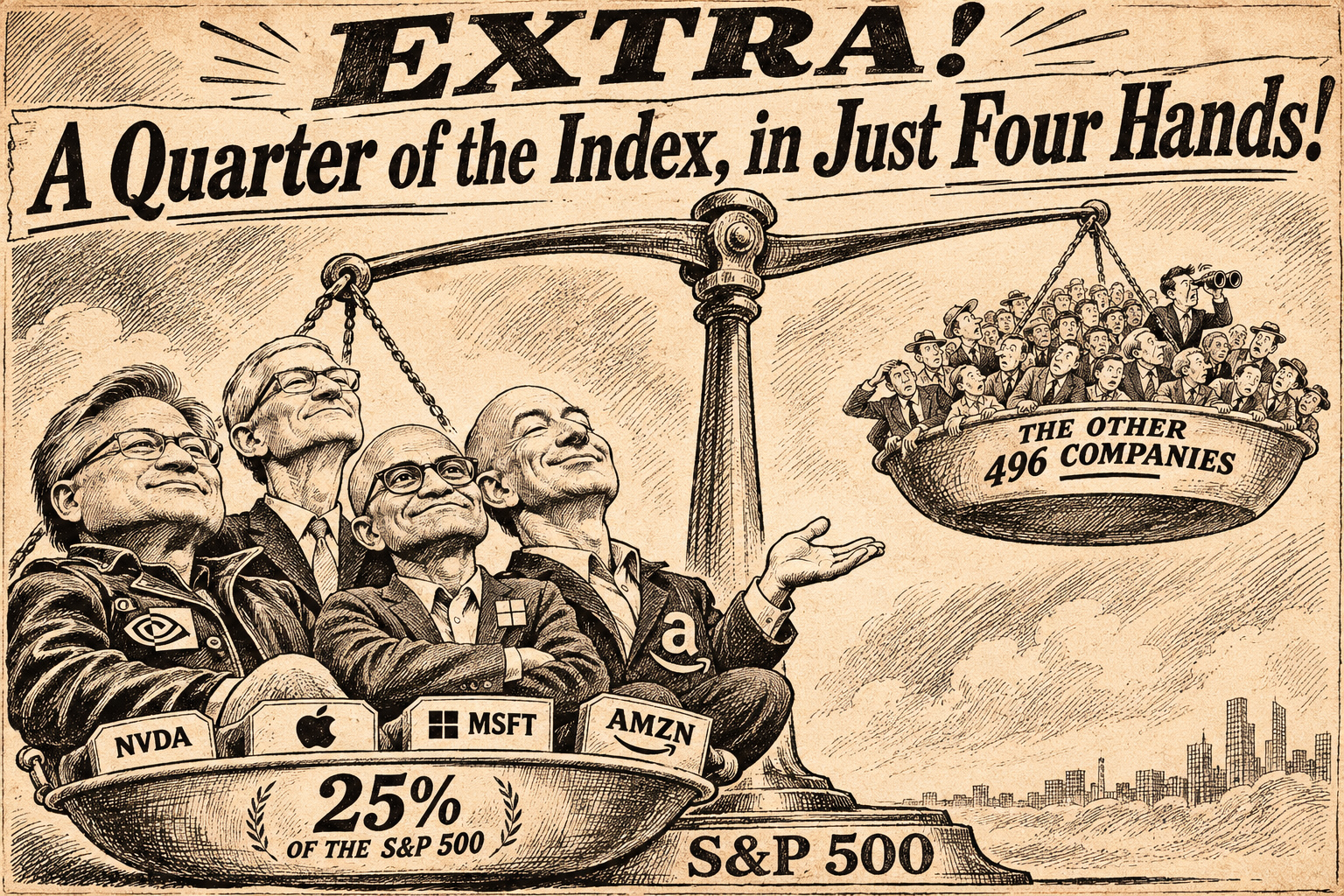
An S&P 500 fund gives you exposure to roughly 500 large U.S. companies. It does not divide your money equally among them. That distinction matters when just four companies account for about a quarter of the fund.
As of October 29, 2026, NVIDIA, Apple, Microsoft, and Amazon together represented approximately 24.96% of the S&P 500, based on the rounded index weights published by State Street. Together, they accounted for approximately 24.94% of State Street's S&P 500 ETF Trust. In round numbers, that is 25%. Other funds tracking the same index generally have similar, though not identical, exposures. Those weights change as markets move.[1]
That figure does not tell us whether those companies are overpriced or whether the market is about to fall. It tells us something more useful for financial planning: a relatively small group of businesses can have a massive effect on a fund many investors use as their primary stock holding.
Understanding S&P 500 concentration risk starts with how the index assigns those weights.
How an S&P 500 fund weights its holdings
The S&P 500 measures the large-company segment of the U.S. stock market. Its constituents are weighted by float-adjusted market capitalization. In plain English, that means a company's weight depends on the market value of its shares available to public investors.[1]
A larger eligible market value means a larger allocation. An equal division across 500 companies would put about 0.2% in each. A market-cap-weighted index gives its largest constituents much more than that.
For every $100 invested in the State Street fund on the date above, approximately $25 was allocated to those four companies. The rest was spread across the remaining holdings. Owning hundreds of companies provides breadth, but the allocation determines how much each company contributes to your results.
These weights can change without an investor or fund manager placing a new bet. If a company's share price rises faster than the rest of the index, its relative weight generally increases. A fund already holding that stock participates in the increase automatically. Share issuance, changes in available public float, and index membership can also affect the weights.
This is how the methodology is designed to work. It allows the portfolio to reflect changes in the market value of its constituents without repeatedly trading back to equal allocations.
It also helps explain why "the whole market" is an imprecise description. An S&P 500 fund covers large U.S. companies across multiple sectors. It does not provide comprehensive exposure to smaller U.S. companies, foreign stocks, or bonds. Whether it provides enough diversification depends on what else you own and what the portfolio needs to accomplish.
What S&P 500 concentration risk changes
Concentration gives the largest holdings greater influence over returns, in both directions. Their gains can support the index, and their losses can weigh on it even when many smaller constituents hold up better.
Consider a simplified illustration. Suppose those four companies together represent 25% of a fund. If that group falls 30% while every other holding stays unchanged, the fund would lose 7.5% from that group alone. This assumes fixed starting weights and ignores expenses and trading. It is arithmetic to illustrate exposure, not a forecast.
There is also a difference between owning separate companies and owning independent sources of risk. Businesses can share customers, suppliers, financing conditions, or expectations about future growth. When several large holdings are sensitive to the same developments, their prices may move together. Counting company names will not fully capture that relationship.
None of this establishes that the largest companies are poor investments. Size alone tells us little about future returns, and a concentrated index can continue to outperform a more evenly weighted one. The planning question is whether the exposure fits the investor's circumstances, including the ability to stay invested through losses.
A household also needs to distinguish concentration within one fund from concentration across its entire portfolio. If an S&P 500 fund makes up 40% of a portfolio, and those four companies make up approximately 25% of that fund, those indirect positions represent about 10% of the total portfolio before counting any overlapping investments.
That last qualification matters. A growth fund, a technology fund, an individual stock account, or employer stock may add exposure to businesses already held in the index fund. Several fund names on a statement can conceal substantial overlap.
What different approaches actually change
There are several ways to change a portfolio's exposure to its largest companies. Each involves a trade-off, and none removes the possibility of losing money.
Equal weighting changes the allocation rule
An equal-weighted approach assigns approximately the same starting weight to each company. S&P's equal-weight version of the S&P 500 resets company weights quarterly, rather than allowing the largest businesses to retain their market-cap-based allocations.[2]
That reduces the influence of the largest companies relative to the conventional index. It also increases the influence of smaller constituents and changes sector allocations. Maintaining those weights requires rebalancing, which can affect turnover and trading costs. Fund expenses also need to be compared.
Equal weighting can lag when the largest companies lead the market. An investor considering it needs to be comfortable with a portfolio that behaves differently from the benchmark most often quoted in the news.
Broader exposure changes the investment universe
A total U.S. stock market fund adds companies beyond the large-cap segment. However, if it is also market-cap weighted, the largest companies can remain prominent. Adding more holdings does not necessarily make the allocation substantially more even.
International stocks introduce exposure to businesses listed outside the United States, along with different economic, political, and currency risks. Bonds serve a different role from stocks and bring their own interest-rate and credit risks. Their suitability depends on the household's goals, time horizon, and need for liquidity.
The useful question is what an additional holding contributes to the overall portfolio. A longer list of funds is not evidence that diversification has improved.
Values screens change which businesses qualify
Faith-based and other values-screened strategies exclude or limit investments according to stated criteria. Those criteria may address business activities, revenue sources, or corporate practices. The actual rules matter more than the label on the fund.
A screened fund may still be concentrated. If it excludes some companies but heavily weights the largest remaining businesses, its top holdings can account for a substantial share of assets. Screening and diversification address different questions and need to be evaluated separately.
Before comparing a screened strategy with a conventional index fund, examine its holdings, weighting method, expenses, sector exposures, and screening policy. Consider how and why its returns might differ from the benchmark, including periods when it could lag. A screen does not establish that returns will be better or worse.
For more background on evaluating these approaches, see my guide to Christian ETFs and biblically responsible investing.
Why the underlying businesses matter to Christian investors
Portfolio construction starts with financial responsibilities: money needed soon, obligations to family, and the capacity to absorb investment losses. For Christian investors, stewardship also includes considering the businesses represented in the portfolio.
Psalm 24:1 begins, "The earth is the Lord's and the fullness thereof." That conviction gives us a reason to examine how entrusted resources are invested, including the activities of the companies we own through funds.
The mechanics deserve precision here. An investor in a stock fund generally owns shares of the fund, which holds shares of underlying companies. Purchases of existing shares in the secondary market generally do not put new cash directly into a company's bank account. Even so, the investment provides an economic interest in those businesses, and their activities remain relevant to an ownership decision.
Concentration can help identify where to begin that review. Learning about a fund's largest positions tells you about a meaningful share of its exposure. But no percentage establishes a moral verdict, and a conventional index allocation is not evidence that someone has neglected their responsibilities.
Christians may reach different conclusions about screening, shareholder engagement, and the practical limits of evaluating public companies. A sound process makes the convictions and trade-offs explicit, then evaluates the available options carefully.
How to review your own exposure
Start with the fund provider's current holdings page. Note the date, the largest positions, and their weights. If the same company appears through multiple share classes, combine those positions when assessing company-level exposure.
Next, put the fund in the context of the full household portfolio. Include retirement accounts, taxable investments, and employer stock where applicable. A fund's concentration matters in proportion to the amount of household wealth invested in it, plus any overlapping exposure elsewhere.
Then identify the concern you are trying to address. Is it dependence on a few businesses, discomfort with the overall stock allocation, overlap across accounts, or a conviction about particular business activities? Those concerns can require different responses. A values screen may not reduce concentration, and equal weighting does not necessarily address an ownership concern.
Before making a change, compare the proposed allocation with the existing one. Consider expenses, expected differences in behavior, rebalancing requirements, and any potential tax consequences in a taxable account. Available investment choices within an employer plan may also limit the options.
A review can reasonably end with keeping the current allocation. It can also reveal a need to adjust the broader portfolio rather than replace a single fund. The decision should follow from the household's needs and convictions, with the holdings data providing context rather than urgency.
An S&P 500 fund can remain a useful part of a portfolio while carrying meaningful concentration in its largest companies. Knowing that allows you to evaluate the allocation for what it actually is.
Want some help thinking this through?
That's part of why I started Openhanded Wealth: to walk with folks like you through decisions that feel complicated, but don't have to stay that way. If you've got questions, reach out. I'm a real person, and I won't pressure you into buying products you don't need.
This content is provided for informational and educational purposes only and should not be construed as personalized investment, tax, or legal advice. Nothing contained herein constitutes a recommendation to buy or sell any security or to adopt any specific investment strategy. Strategies discussed may not be appropriate for all individuals and depend on each person’s unique financial circumstances. Investment advisory services are offered only pursuant to a written advisory agreement.
My goal is to use whatever gifts I have received to serve others, as a faithful steward of God’s grace in its various forms. (1 Peter 4:10)
Better is a handful, with quietness, than two handfuls with labor and striving after wind. -Ecclesiastes 4:6
Take the next step towards openhandedness and financial peace by booking a meeting with a Christian Financial Planner.